Whole-home sound, indoors and out.

Cinematic experience at home.

High-quality sound for any outdoor space.

Effortless light and privacy control.

Play, practice, and compete from home.

Beautiful, functional lighting for every space.

Fast, reliable Wi-Fi and connectivity.

Integrated technology for smarter workplaces.

Interactive spaces built for learning and collaboration.

High-end AV solutions for impactful meetings.

Custom audio-visual for any business environment.
Lighting & shading design for fine homes.

Architectural, decorative, and landscape lighting.

Shades, drapery, and motorized porch screens.
Lutron & Control4 scenes, schedules, and keypads.
Free AI landscape-lighting preview.
Send us your plans for a lighting layout.

Expert planning for tailored AV solutions.

Professional setup for flawless performance.

Maintenance plans and priority support that keep your system running like new.

Meet the Experts Behind the Sound

Delivering exceptional AV experiences

Quick answers to common questions

Real ballpark pricing, no surprises
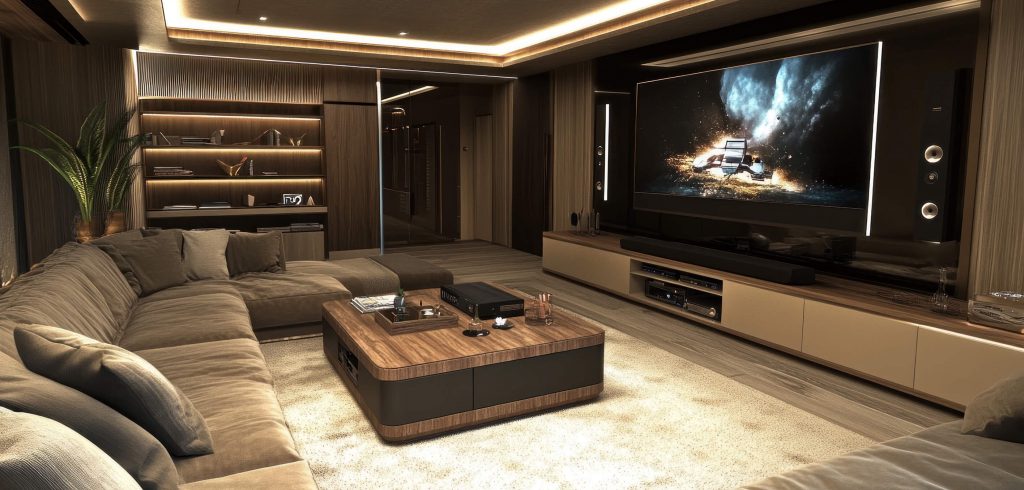
A media room is the room your family already lives in, designed to become a theater when the sun goes down — without looking like one at two in the afternoon. A large display instead of a projector, surround speakers hidden in the walls and ceiling, a subwoofer you cannot find, lighting that drops to a scene when the movie starts, and one remote that runs it all. Phantom Sound has been designing media rooms for Cincinnati great rooms, lower levels, and bonus rooms since 1988.
If the room has one job, build a dedicated theater. If the room has to host Saturday morning cartoons, Sunday football, and a Friday movie, build a media room. Most Cincinnati homes want the second — and it costs a fraction of the first.
Media room design is mostly about restraint. The display is sized to the seating distance, not to the largest box at the store. Speakers are in-wall and in-ceiling Sonance or Klipsch, painted to disappear; the subwoofer hides in cabinetry or the floor. Daylight is handled with motorized shades rather than a darker TV. And the whole thing runs from a Control4 or Josh.ai system, so “movie” means the shades drop, the lights fade, and the display, receiver, and streaming box all come on together. Done this way, the room looks like a living room and sounds like a theater.
Sony, Samsung, or LG displays sized to the room, mounted at the right height with concealed cabling — or a laser projector with an ambient-light-rejecting screen where the room can be darkened.
In-wall and in-ceiling speakers with paintable grilles, Dolby Atmos height channels in the ceiling, and a concealed subwoofer. No black boxes on the floor.
Lutron dimmers and shades on scenes: “movie,” “game,” “clean up.” Tunable fixtures keep the room comfortable during the day and cinematic at night.
We plan speaker and display placement around your furniture and sightlines, coordinating with your designer so the room still reads as a living space.
Control4 or Josh.ai runs display, audio, streaming, lighting, and shades from one remote, keypad, or voice command. The babysitter can run it.
— Phantom Sound, on designing for the room you live in
The most common project: a large display over the fireplace or on a media wall, hidden surround, and lighting scenes in an open floor plan.
Lower levels in Mason, Indian Hill, and Loveland often become hybrid rooms — media room by default, theater with the shades down, golf simulator on the weekend.
Bonus rooms over the garage make excellent media rooms once the acoustics and light are handled.
Pre-wiring the media wall, speaker locations, and shade power during framing makes the finished room cleaner and less expensive. See new construction AV.
A media room built around a display, hidden surround speakers, and lighting control typically lands well below a dedicated theater, which starts around $10,000 and runs $25,000–$80,000 for mid-range rooms. We quote from a free consultation; ranges are on our pricing page.
Yes. We design speaker and display placement around how the room is already used, and coordinate with your designer if the room is being refreshed.
Electronics live in a closet, cabinet, or a small rack nearby. Nothing visible in the room except the display and the remote.
Yes, with blackout shades and an ambient-light-rejecting screen. For most daytime rooms a large display is the better choice.
Yes — the media room becomes a set of scenes in your Control4, Josh.ai, or Lutron system alongside the rest of the house.
Free in-home consultation. We look at the room, sightlines, and light, then give you a written design and price. Serving Greater Cincinnati, Northern Kentucky, and Dayton.