





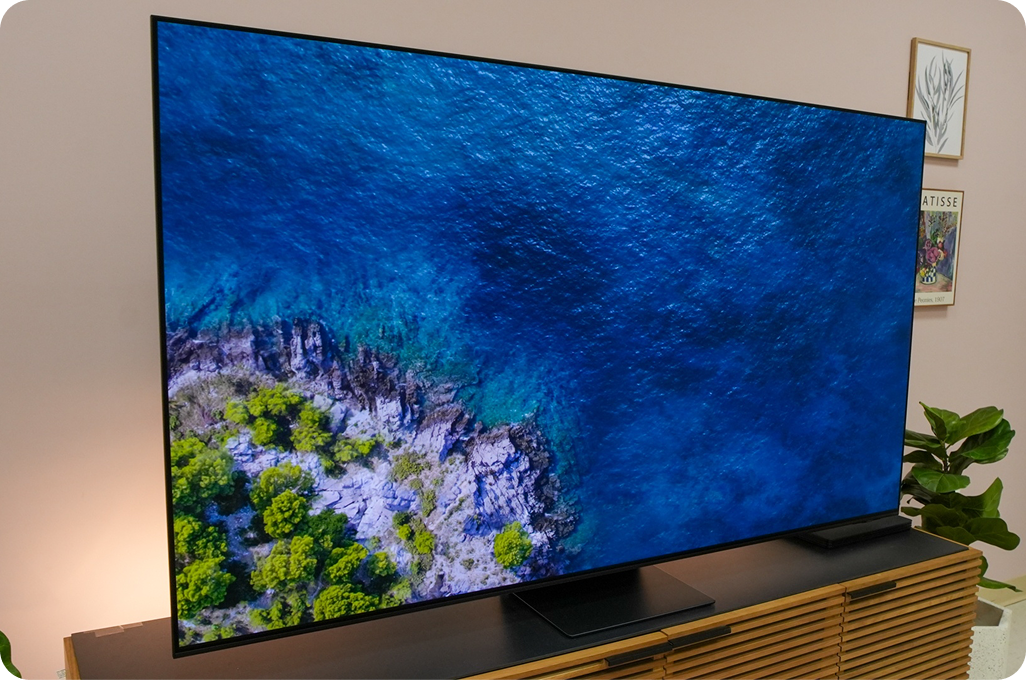
Walk into any electronics store or showroom in 2026 and you’ll see them everywhere: 8K TVs being marketed as the next evolutionary step beyond 4K. On paper, they seem very impressive. Televisions with 8K have four times the resolution of 4K TVs. They deliver sharper detail and a more lifelike image.
But here’s the reality: The enhanced resolution of a TV alone doesn’t determine picture quality. For many homes, 8K doesn’t deliver a meaningful upgrade and the investment becomes a waste of money.
At Phantom, we spend a lot of time helping clients make smart investments in their home technology. Let’s break down where 8K truly makes a difference and where it doesn’t.
What 8K Actually Means
The term “8K” refers to a TV that has nearly 8,000 pixels horizontally. An 8K display has a resolution of 7680 × 4320 pixels. Compare that to a 4K TV that has 3840 × 2160 pixels. The screen of an 8K TV has over 33 million pixels, while a 4K TV only has 8.2 million.
You might think that 33 million pixels would deliver a significant difference in picture detail. However, more pixels does not necessarily equate to better resolution. The following three factors must be 8K compatible, as well.
- The content must support 8K, meaning that the stream, disc or broadcast content is in 8K
- The system you’re using must be able to deliver the 8K content
- When watching your 8K TV, you’re sitting close enough to actually see the difference.
Without all three factors in alignment, those extra pixels don’t translate into a better experience.
There is Very Little Native 8K Content
This is the biggest limitation today. There just isn’t the same amount of 8K content out there, as there is 4K content.
- Most content on streaming platforms is still 4K, and heavily compressed
- Blu-ray (Ultra HD) maxes out at 4K and currently, there is no consumer 8K disc format available
- Broadcast TV, or over-the-air, is still largely delivered in either 1080p or 720p.
- This is well below the 7680 × 4320 format of 8K TVs.
When faced with these facts, an obvious question arises: If the content isn’t native 8K content, then what are you seeing when you watch an 8K TV? Primarily, you’re viewing upscaled 4K or HD content. Modern TVs do a decent job with upscaling, but you’re not seeing true 8K detail. It’s an interpretation of lower-resolution content.
Bandwidth: The Hidden Cost
Even if native 8K content becomes more common, there’s another major hurdle to overcome: Streaming bandwidth. That is, the bandwidth needed to transmit the higher resolution picture 8K offers. Consider these facts:
- A high-quality 4K stream already requires 15–25 Megabits per second (Mbps)
- True 8K streaming can require 50–100 or more Mbps. Streams with higher bitrates could need more.
Of course, all of this is assuming that there is a strong, stable internet connection, a network that can handle sustained high throughput and a minimal compression (which most services still rely on) .
In many homes, it will be the network, not the 8K TV, that will be the bottleneck.
Viewing Distance: Can You Even See the Difference?
A gain in picture resolution only matters if your eyes can perceive the added detail.
In most American homes, viewers will sit between 8–12 feet away from a 65” or 75” TV. At those distances, the difference between 4K and 8K is negligible. You won’t really see the difference.
But where 8K TV can make a difference is in media rooms or home theaters where the screen is 85” inches or more. Viewers will also need to be sitting closer to really appreciate the additional resolution.
In those environments, the increased pixel density can create a smoother image.
HDMI 2.1b and System Requirements
To support an 8K TV properly, your system needs to be built for it. These are some of the factors you’ll need in place:
- HDMI 2.1b connections – This newer HFMI version delivers 48 Gigabits per second (Gbps) and supports 8K content. It can even go up to 10K!
- Compatible 8K content sources, which are still limited
- Proper cabling which is rated for high data transfers.
Without the right equipment infrastructure, you’re not getting the full benefit of 8K, even if you own an 8K TV.
Where 8K Doesn’t Deliver Real ROI
To review, 8K will largely be an under-utilized, very expensive option for most homeowners. Especially if the following is true:
- You primarily stream TV content
- You watch cable or broadcast TV
- Your TV is in a living room where you sit 8-12 feet away.
In short, with an 8K TV, you probably won’t see a meaningful improvement over a high-quality 4K display. In fact, a properly calibrated 4K system with better contrast, color accuracy, and lighting control will often outperform an 8K TV in real-world viewing.
Where 8K Actually Makes Sense
While having just an 8K TV without upgrading your system might not make financial sense, there are scenarios where 8K is a smart investment. These include:
- High-end home theaters with large projection-style viewing
- Commercial or showcase environments where image detail is critical
- Clients who want future-ready systems.
In these cases, 8K can provide a level of refinement that 4K can’t match, especially when paired with the right content and calibration.
The Bottom Line
An 8K TV is not a bad investment, it’s just a very specific one. The technology is impressive, but the ecosystem needed to see true 8K is still catching up. For most homes today, the better investment is in:
- Improving display quality, not just the resolution
- Ensuring your system is properly designed
- And a setup tailored to how you actually watch your content.
At Phantom, that’s always our goal. We don’t want to sell you the newest technology. We want to make sure you have the right technology for your space.
Related Resources
Invisible Integration: 2026’s Most Advanced Hidden AV Solutions for Ultra-Luxury Residences
CES 2026 Debrief: The 7 Breakthrough Technologies That Will Define Luxury AV This Decade
How do I Get a Smart Home System Installed in My Home?
Getting Started
Are you interested in adding a 4K or 8K display in your home? Then call Phantom today at 513-759-4477. We’ll come out for a free consultation.
Phantom Sound- We help you enjoy your space!